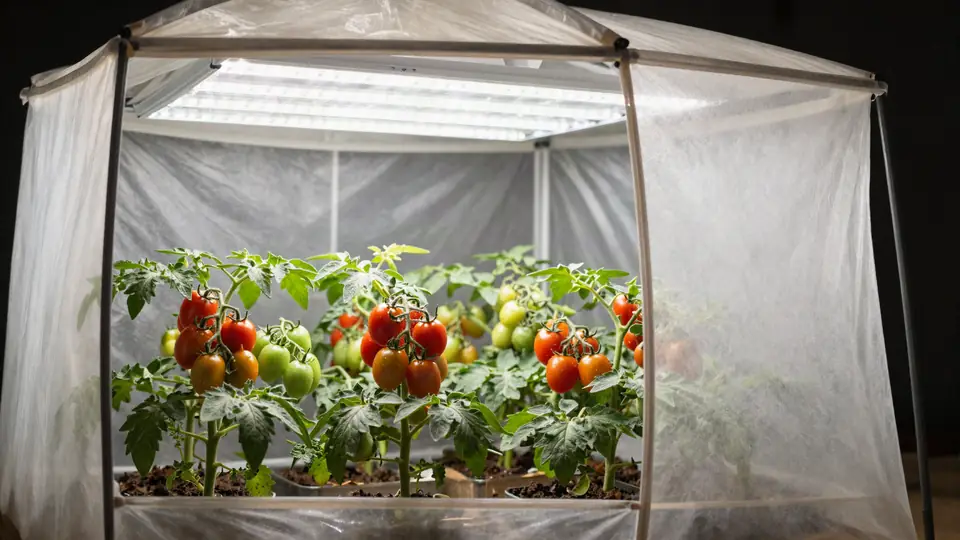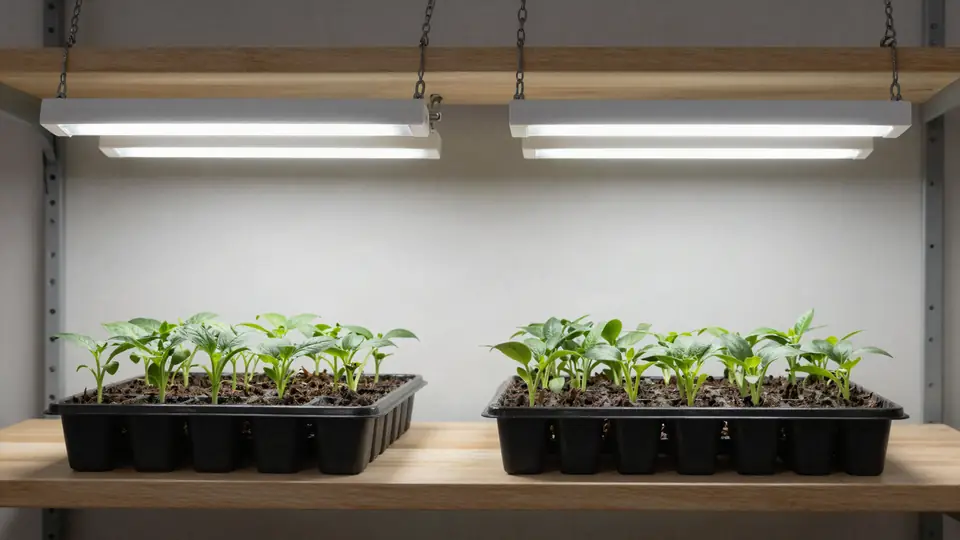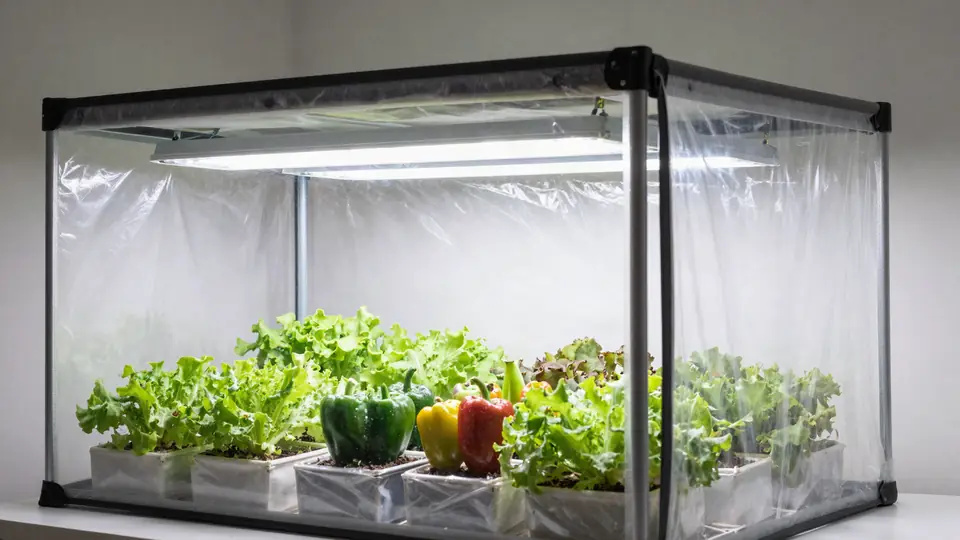
Short answer: with an efficient LED, a 2 × 4-foot tent needs about 80 to 100 actual watts for leafy greens and herbs, and about 130 to 195 actual watts for productive tomatoes and peppers. If you want to grow both, buy a dimmable light that draws around 200 watts.
Watts by crop
| Crop | DLI target | Average PPFD | Actual watts | Watts per sq ft |
|---|---|---|---|---|
| Seedlings | About 6–12 | 105–210 | About 40–80 W | 5–10 |
| Leafy greens and herbs | 12 or more | 210 | About 80 W | 10 |
| Fruiting crops, minimum | 15 or more | 260 | About 100 W | 12 |
| Productive tomatoes, good | About 20 | 350 | About 130 W | 16 |
| Productive tomatoes, strong | About 25 | 435 | About 160 W | 20 |
| Productive tomatoes, upper target | About 30 | 520 | About 195 W | 24 |
Michigan State University lists a DLI of 12 or more for leafy greens and herbs, and 15 or more for fruiting vegetables. The higher tomato targets come from a lighting vendor citing Virginia Tech Extension, and the seedling range comes from secondary sources, so treat both as guides rather than fixed rules.
How we get to those numbers
- Start with the daily target. DLI is the total light a crop gets in a day.
- Convert it to PPFD. PPFD = DLI ÷ (hours × 0.0036). Over 16 hours, a DLI of 12 needs about 210 PPFD.
- Multiply by the area. A 2 × 4-foot tent covers 0.74 m².
- Divide by what the light delivers. At 2.5 µmol/J, with 80% of the light reaching the plants, each actual watt delivers 2 µmol/s to the canopy.
For leafy greens, that gives 210 × 0.74 ÷ 2 = about 78 watts. You can test your own schedule in the DLI calculator.
What if your light is less efficient?
The table assumes a good LED. A basic light at 2.0 µmol/J needs 25% more power for the same result, so 160 watts becomes about 200. If a listing doesn't state its efficacy, it's safer to allow for this extra power.
Always use the actual power draw. "Equivalent" wattage is a marketing figure and doesn't tell you how much light reaches your plants.
What it costs to run
| Actual watts | Monthly use | Monthly cost |
|---|---|---|
| 80 W | 38.4 kWh | About $6.99 |
| 100 W | 48.0 kWh | About $8.74 |
| 130 W | 62.4 kWh | About $11.36 |
| 160 W | 76.8 kWh | About $13.98 |
| 195 W | 93.6 kWh | About $17.04 |
Your rate may be quite different. Enter it in the grow light cost calculator.
Why the shape of a 2×4 tent matters
A 2 × 4-foot tent is twice as long as it is wide. One small square panel in the middle will leave both ends dim, even if its wattage looks right on paper. Plants at the ends will then grow more slowly and lean toward the center.
- Choose a long light. A bar-style fixture or a rectangular panel spreads light along the tent.
- Or use two smaller lights. Two lights of about 100 watts, one over each half, can also give even coverage.
- Check the PPFD map. Look for one that covers a 2 × 4 area at a stated hanging height, and compare the end values with the center.
- Group crops by need. Put hungrier plants under the brightest part and greens toward the ends.
What to look for
For greens and herbs
A dimmable LED drawing about 100 watts is enough. Long bars suit this tent shape well. See 100-watt LED bars on Amazon.
For tomatoes and peppers
Look for about 200 actual watts, with a dimmer so that you can start low. See 200-watt LED lights on Amazon.
Timer and airflow
A timer keeps your schedule steady, and a small fan moves air around the plants. See clip-on tent fans on Amazon.
Plan for the heat
Nearly all the electricity a light uses ends up as heat. A 160-watt light adds about 550 BTU per hour to the tent, so a closed tent can warm up quickly. Vent warm, humid air out, and check the temperature at plant height.
Use properly rated outlets, keep water away from connections, and follow the maker's hanging height. Leaves that bleach or curl upward can be a sign that the light is too close or too strong.
Growing tomatoes in a larger space?
Read our guide to the grow light for a 3 × 3 tent of tomatoes. If you only need to start seeds, a 4-foot seedling shelf uses far less power.